How to Improve Google Ads Quality Score in Houston
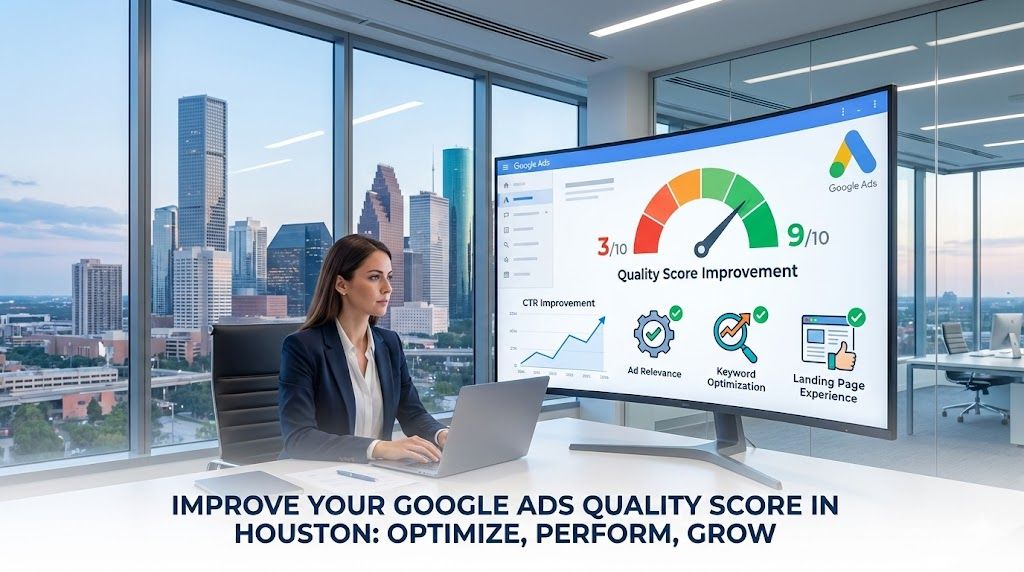
Improving Google Ads Quality Score in Houston is one of the most effective ways to reduce advertising costs and generate more leads from the same budget.
In a competitive market like Houston, businesses often face high cost-per-click (CPC) and intense competition. Many advertisers try to solve this problem by increasing bids, but that approach usually leads to higher costs, not better performance.
Quality Score is Google’s way of rewarding relevance and user experience. When improved correctly, it allows your ads to rank higher while paying less per click.
This detailed guide explains how to improve Google Ads Quality Score in Houston, why it matters so much, what factors affect it, and the exact optimization steps that lead to long-term success.
What Is Google Ads Quality Score?
Quality Score is a metric Google assigns to each keyword in your account, measured on a scale from 1 to 10. It reflects how relevant and useful your ad is to users.
Quality Score is based on three core components:
Expected click-through rate (CTR)
Ad relevance
Landing page experience
A higher Quality Score means Google views your ads as more helpful to users.
Why Quality Score Matters More in Houston
Houston is one of the largest and most competitive PPC markets in the United States. Many industries face aggressive bidding, especially local services, legal, medical, and professional sectors.
In Houston:
High competition pushes CPC upward
Poor Quality Scores become expensive quickly
Small inefficiencies scale into large losses
Improving Quality Score is often the fastest way to reduce CPC without sacrificing visibility.
How Quality Score Impacts Google Ads Cost
Quality Score directly affects Ad Rank, which determines:
Whether your ad shows
Where your ad appears
How much you pay per click
Higher Quality Score leads to:
Lower CPC
Better ad positions
Higher impression share
Lower Quality Score results in higher costs and reduced visibility, even with higher bids.
The 3 Main Factors That Influence Quality Score
1. Expected Click-Through Rate (CTR)
Expected CTR measures how likely users are to click your ad when it appears.
CTR is influenced by:
Keyword relevance
Ad copy quality
Use of ad extensions
Competitive positioning
In Houston markets, strong CTR is essential because users see many competing ads.
2. Ad Relevance
Ad relevance measures how closely your ad matches the user’s search intent.
Low relevance occurs when:
Ads are generic
Ad groups contain unrelated keywords
Messaging does not match search intent
High relevance improves Quality Score and user engagement.
3. Landing Page Experience
Landing page experience evaluates how useful your page is to users after they click.
Google looks at:
Page load speed
Mobile friendliness
Content relevance
Transparency and trust
Poor landing pages can drag down Quality Score even if ads are well written.
Step 1: Fix Keyword Intent and Targeting
Keyword intent is the foundation of Quality Score improvement.
Focus on High-Intent Keywords
High-intent keywords match users ready to act.
Examples include:
Service-based keywords
Location-modified searches
“Near me” searches
Emergency or same-day intent
Avoid informational keywords that attract impressions but not clicks.
Control Keyword Match Types
Broad match keywords often lower CTR.
Best practice for Houston:
Use exact match for core services
Use phrase match for controlled expansion
Limit broad match unless aggressively monitored
Better match control improves relevance and CTR.
Step 2: Improve Account and Ad Group Structure
Poor structure is a major Quality Score killer.
High-performing structures include:
Separate campaigns by service or product
Tightly themed ad groups
No mixing of unrelated keywords
Separation of branded and non-branded traffic
Tight structure improves ad relevance and CTR automatically.
Step 3: Write Highly Relevant Ad Copy
Ad copy plays a huge role in Quality Score.
High-Quality Score ads:
Include primary keyword themes
Match user intent clearly
Use strong calls to action
Avoid vague or generic messaging
Ads should directly answer what the user searched for.
Step 4: Use Ad Extensions to Boost CTR
Ad extensions improve visibility and engagement, which supports higher CTR.
Important extensions include:
Call extensions
Location extensions
Sitelinks
Callouts
Structured snippets
Higher CTR from extensions improves expected CTR signals.
Step 5: Optimize Landing Pages for Relevance
Landing page relevance is critical for Quality Score.
High-quality landing pages:
Match ad and keyword messaging exactly
Focus on one service or offer
Load fast on mobile
Include clear calls to action
Show trust signals like reviews and credentials
Sending traffic to generic homepages often damages Quality Score.
Step 6: Improve Mobile Experience
Houston has strong mobile search volume, especially for local services.
Mobile issues that hurt Quality Score:
Slow load times
Difficult navigation
Non-clickable phone numbers
Poor form usability
Mobile optimization improves landing page experience ratings.
Step 7: Use Negative Keywords Strategically
Negative keywords improve Quality Score by filtering irrelevant impressions.
Benefits include:
Higher CTR
Better ad relevance
Improved engagement
Regular negative keyword updates are essential in broad Houston markets.
Step 8: Monitor Quality Score at the Keyword Level
Quality Score should be reviewed at the keyword level, not account-wide.
Track:
Quality Score trends
CTR by keyword
CPC changes
Impression share
Focus on improvement trends rather than isolated scores.
Step 9: Remove or Pause Low-Quality Keywords
Some keywords simply do not perform.
During optimization:
Pause keywords with low CTR and no conversions
Replace them with more specific variants
Consolidate overlapping keywords
Fewer, higher-quality keywords often outperform large bloated lists.
Step 10: Align Ads, Keywords, and Landing Pages
Quality Score improves when everything aligns.
Strong alignment means:
Keywords match ad headlines
Ads match landing page content
Landing pages fulfill search intent
Misalignment is one of the most common Quality Score problems.
Step 11: Improve Page Speed and Technical Performance
Technical performance matters.
Improve landing page experience by:
Compressing images
Reducing scripts
Improving hosting
Optimizing mobile performance
Faster pages lead to better user experience scores.
Step 12: Understand Industry Differences in Houston
Quality Score challenges vary by industry.
Examples:
Home services: urgency-driven, strong CTR potential
Legal: extremely competitive, Quality Score critical
Healthcare: trust and compliance matter
Ecommerce: product page relevance dominates
Industry-specific optimization delivers better results.
Step 13: Be Patient With Quality Score Improvements
Quality Score does not change instantly.
Typical improvement timeline:
1–2 weeks: CTR improvements
2–4 weeks: landing page impact
1–2 months: stable Quality Score gains
Consistency matters more than speed.
Common Quality Score Mistakes Houston Businesses Make
Avoid these errors:
Using overly broad keywords
Writing generic ads
Sending traffic to poor landing pages
Ignoring mobile experience
Not reviewing search terms
These mistakes increase cost and reduce performance.
Quality Score vs Conversion Rate: Why Both Matter
Quality Score controls cost and visibility.
Conversion rate determines profitability.
The best Houston campaigns optimize both together.
When Professional Optimization Makes Sense
Improving Quality Score requires:
Strategic restructuring
Continuous testing
Technical landing page optimization
Deep keyword intent analysis
Many businesses partner with a professional Google Ads Agency In Houston to improve Quality Score while controlling costs and scaling campaigns effectively.
Checklist: Improving Google Ads Quality Score in Houston
- Focus on high-intent keywords
- Tighten ad group structure
- Write keyword-focused ad copy
- Use all relevant ad extensions
- Optimize landing pages for relevance and speed
- Improve mobile experience
- Add negative keywords regularly
- Monitor Quality Score trends
Following this checklist resolves most Quality Score issues.
Long-Term Benefits of High Quality Score
Sustained Quality Score improvements deliver:
- Lower CPC
- Better ad positions
- More leads from the same budget
- Stronger scalability
Quality Score gains compound over time.
Final Thoughts
Learning how to improve Google Ads Quality Score in Houston is one of the smartest investments a business can make in paid search. In a competitive market, Quality Score often determines whether campaigns are profitable or painfully expensive.
Instead of increasing bids, businesses that focus on relevance, intent, and user experience gain a powerful advantage. When keywords, ads, and landing pages align perfectly, Google rewards you with lower costs and better visibility.
With consistent optimization and the right strategy, Quality Score becomes more than a metric—it becomes a competitive weapon that turns Google Ads into a predictable, scalable growth channel for Houston businesses.